
Conjuring thee Counter-Image
antipathetic intimations of a former incarnation


This post is the second in a series dedicated to a 3-part workshop I’m facilitating for the Anthroposophical Society of America titled “The Serpent of Destiny.”
A Short Review
In the last post and first session, I left off with this great quote from Owen Barfield’s Saving the Appearances for contemplation:
For non-participating consciousness it is either, or. A narrative is either a historical record, or a symbolical representation. It cannot be both; and the pre-figurings of the New Testament in the Old, and the whole prophetic element in the Old Testament is now apt to be regarded as moonshine. In a parallel sphere, however—the life-history of the individual man—it is already no longer taken quite so confidently for granted that the historical and the symbolical are contradictories. In the nineteenth century it required the powerful imagination of a John Keats to perceive that every man’s life is a perpetual allegory. In our own day the development of psychology [think here of Freud and Jung with their emphasis on myth, dream, and symbol] alone has made this possible for much more ordinary men. Though not many may agree with him, a man is no longer regarded as a lunatic, who divines that the things which happen to a person, and the order in which they happen, may be as much a part of him as his physical organism. And it seems to lie in the natural order of things that, with the further increase of final participation, this perception should be extended to the biographies of nations and races, and of humanity as a whole.1
The notion that the events which befall us and their order are as much a part of our being as our psycho-physical organisms was something participants and I explored through a semantic history of the words “fate” and “destiny.” It became apparent to us that these words—overlapping in meaning, yet distinct enough for destiny to historically connote more agency (having been used as a verb by various Latin-speaking officials to order their underlings and plans, later to be appropriated by Christian theology)—shore up a tension in our general intuition of life’s meaningful shape: there seems some sort of fated plan (however flexible), yet one that requires we creatively participate in its unfolding.
Prior to our exercise in semantic history, I introduced the “Serpent of Destiny” as an image of that transpersonal dimension of human beings spoken about in many spiritual traditions—that which metamorphoses across the morphology of our incarnations. The numinous character of a luminous serpent shedding many skins was called upon to evoke a sense for this divine aspect of ourselves slumbering lucidly below the threshold of our dulled ordinary awareness.
Having reviewed these elements, I’ll ask participants to share any personal insights they have around the feeling-qualities which attend moments of recognizing fate or destiny at work in life. What has it felt like for you? Leave a comment and let me know. For me, it is dim feeling of familiarity, a feeling that there is some history echoing in present interpersonal dynamics, echoes that I can’t merely reduce to Freudian familial patterns.
Experiencing Metamorphosis
Before advancing to more ideas, I first want to bring you through an experience. Below are colored images. Please allow the red image to fill your screen by expanding this window. Stare at it for 30 seconds. Then advance to the white image below it immediately.


The effect might not work so well here, but if you were to allow the red to fill your screen and then abruptly look to a neutral color like white, the typical result is that you see the complement of red (cyan blue) for a time before your eyes readjust to recognize the plain white image. Goethe and Steiner both interpreted this physiological effect as an expression of the fundamental unity of human perception with the life of nature. Through the generation of the complementary color, our physiology seeks to create a harmony between the polar extremes. Through such an exercise we are granted access to this fundamental aspect of reality and the key characteristic of its temporal process (metamorphosis)—polarity and their non-identically repeating play of inversion. Try it again, and see red.


Metamorphosis can be described as change with continuity—when something transforms, yet retains identity. As demonstrated above, and in countless other phenomena (like the process of plant growth depicted in the image below) metamorphosis is driven by the creative play of polarity. The wholeness achieved by our visual apparatus and its colored counter-images expresses another feature that Barfield, Steiner, and Coleridge (following Schelling) attributed to polarity: that it is metaphysically anteceded by unity, and so must be conceived as a tri-unity. The perpetual play of opposites is driven by the compulsion to restore the lost unity in ever-novel ways.
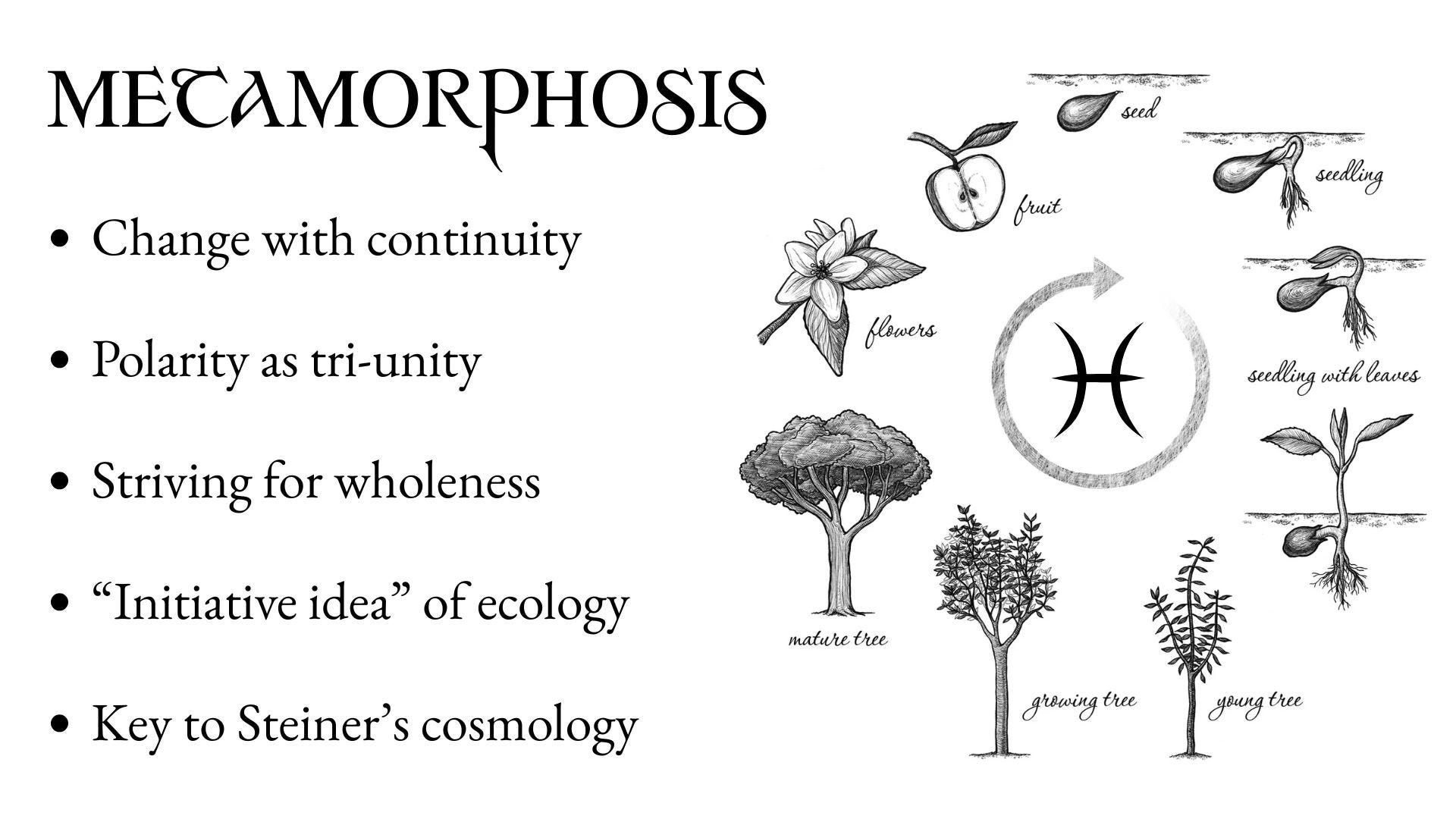
As Barfield suggests in his introduction to the 1977 edition of The Rediscovery of Meaning and elsewhere, Steiner’s method and cosmology reflect a systematic approach to participating the polarities of experience, attuning ourselves through their fluctuations to the metamorphic network of Creation. This is why Barfield suggests in What Coleridge Thought that polarity may be described as the “initiative idea” of ecology—the principle that connects the kingdoms of nature, which we can asymptotically participate and gradually increase to alight in a living knowledge of the world.
As I mentioned in my first post, one of the reasons I initially found Steiner compelling is that he attempts to apply Goethe’s method to perceiving our evolutionary past, efforting to research the morphologies of individual and collective reincarnation cycles. As with Goethe’s practice of exact sensorial imagination to reconstruct the continuous metamorphosis of a plant (which we cannot—except for with cameras—observe all the time and so must artificially add the in-between phases through imaginative reconstruction, leading (one hopes) to an eventually intuition of the spiritual process that is the plant), Steiner recommends artificing a memory of our former incarnation by attending to everything we personally find antipathetic in this life—producing, eventually, a counter-image of ourselves2
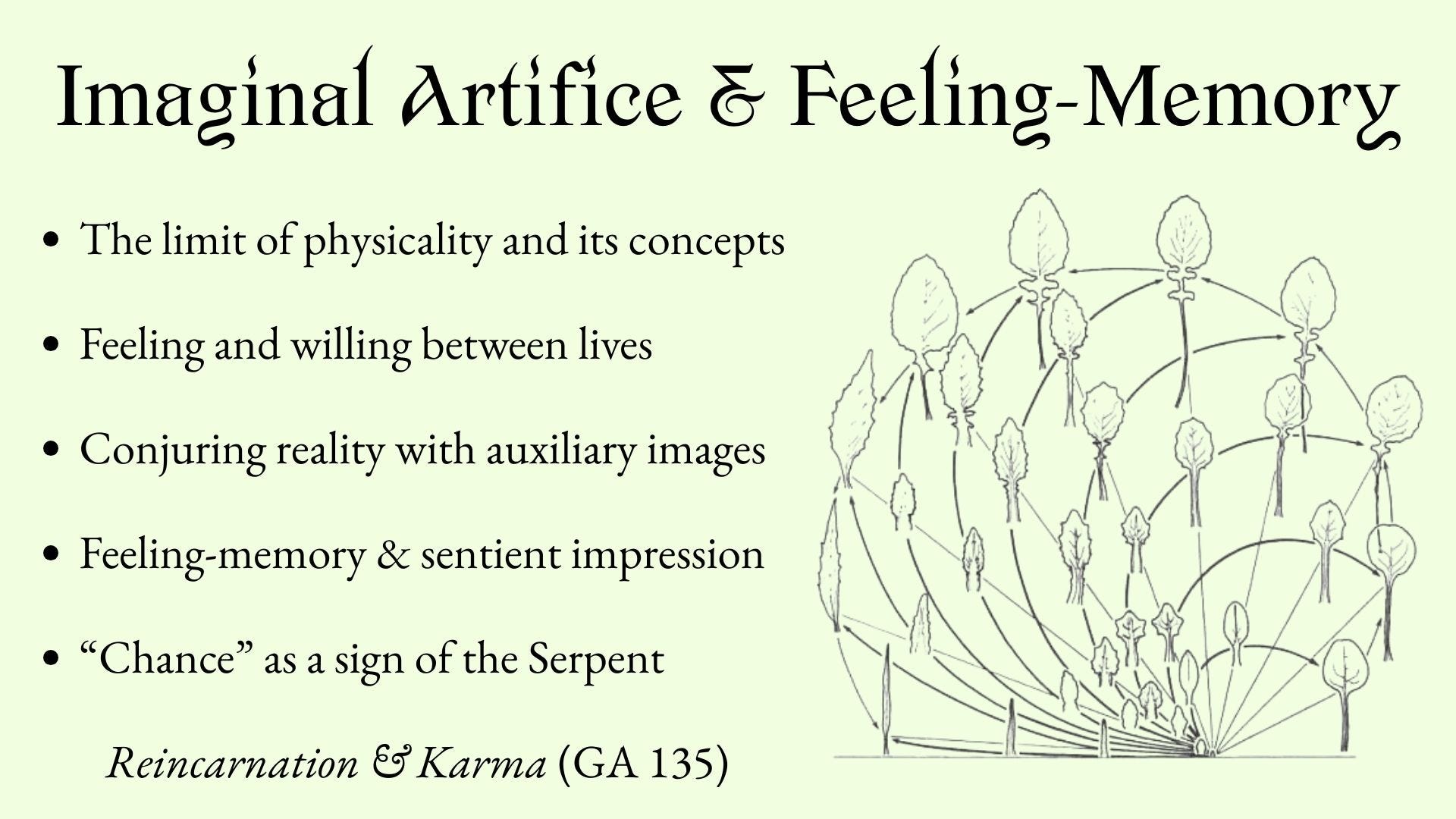
Whereas the study of color requires that we use our eyes and the concepts we derive from observing the physical world, the phenomenon studied in reincarnation research requires instruments that span between lives. According to Steiner, the concepts we derive from the physical world dissolve along with our bodies upon death, rendering them not so useful in lifting the Serpent’s veil. Instead, we are better suited to work in the medium of feeling and desire—processes which do apparently pass between lives. And because polaric inversion is the hallmark of metamorphosis, Steiner recommends that we go through a process of self reflection to identify everything—since birth—that we have disliked, had no aptitude for, wished to avoid, etc—the antipathetic element. For example, I have always been terrible at math; I got bulled quite a bit (which I got quite good at avoiding!); and was never very coordinated enough to play most sports (except for long-distance running, which requires very little coordination and teamwork). If we can repeatedly marinate in the antipathetic elements of our irreducibly unique biographies, desiring everything which we did not and still do not like, including the seemingly accidental or chance-like events of misfortune that have befallen us, we will supposedly gradually conjure up a glimmer of the personality we were in a former life. During the workshop I plan to invite participants to take 10 minutes to write about these antipathetic factors of life and then to spend 5 minutes afterwards stoking desire for them.
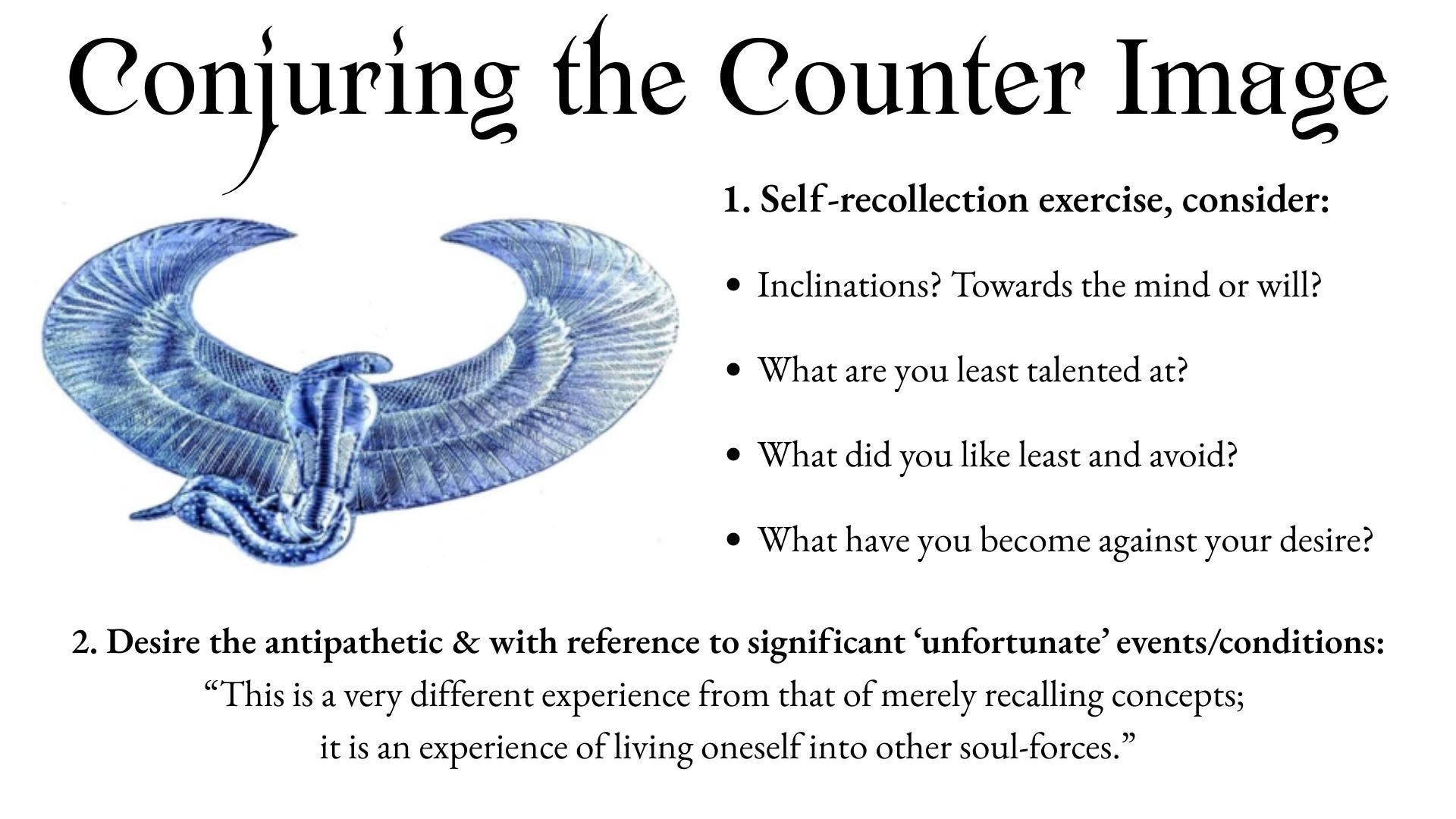
Steiner says that this process is like trying to remember something: it’s on the tip of your tongue, you can feel it somewhere dimly—the word, the name, the memory. You try to fish it up by association, throwing out names or adjectives or such like… Still nothing. Then, suddenly—aha! I remember! Through the artifice of constructing our counter-image—for me, perhaps, a woman who excels at math!—we stir the depths, coaxing the Serpent. This artificial image is not what we seek, but merely an inner prosthetic to conjure the real thing which may one day suddenly break the surface of conscious awareness in the form of “sentient impressions”—as if registering the presence of another soul.
If reincarnation is a reality, I think the Serpent is a nice image for encompassing the many skins we must have accumulated over the eons. The character of the Serpent also partakes of Steiner’s attribution of cleverness to the slumbering One, along with his emphasis on in the depths. But in addition to reflecting on our chance-seeming moments of misfortune (events that were not clearly brought about by our own shortcomings, etc.) or antipathetic conditions we manage to extricate ourselves from, Steiner also invites us to recollect moments when some blessing came into our lives in the same manner of chance. Instead of framing such events as owing to the unconscious desires of our clever One slumbering in the depths, Steiner suggests we look upon such moments as gifts from the spiritual world that have nothing to do with our merit. In short, these are moments of Grace. Try reflecting on such moments in your life and framing them in just that way—5 minutes at least.
I recently had an experience like this and it was actually the reason I had to push the second session of the workshop back a week. I lost my passport while traveling to Frankfurt to pick up my student visa. The great misfortune was that my passport was all I needed in order to pick up the long-awaited visa, and I only realized it was gone just as I was getting ready to leave for my appointment with the consulate. I felt it was obviously my fault: I was anxious in the train station, believing I was on time, but not prepared for the surprise that I would need to wait in line to travel internationally (I had assumed, based on counsel from a friend, that it would be easy as a train transit in Switzerland—merely pressing buttons on the machine). The only other option was to buy the ticket with my phone, but it wasn’t working for some reason, so I got my passport out assuming I’d need to show it to the clerk upon buying my ticket. I tried once more to buy the ticket with my phone and somehow it worked, but now I only had 5 minutes to make the train. I immediately took off running and must’ve dropped my passport at that very moment (it was later found there by Basel SBB staff).
The stroke of good fortune was that I was able to get an emergency passport and pick up the visa only a day later—a miracle in place of what could have been a bureaucratic nightmare, for I was stuck in Frankfurt until I could get a new passport, broke and racking up more debt on my credit card to pay for another hotel room. But for some inexplicable reason, things worked out quite well and I was back in Switzerland the next day with fresh impetus to cultivate more presence and calm, more groundedness and pragmatic strategy (perhaps more like a mathematician or geometer than the dreamer that is my usual character in this lifetime). It certainly did not feel like something I deserved, but rather a gift to thank the gods for—a move the clever (and yet pious) One in my depths may have inspired.
Owen Barfield, Saving the Appearances, (CT: Wesleyan University Press, 1988), 151.
Karma and Reincarnation (GA 135) https://rsarchive.org/Lectures/GA135/English/SBC1977/ReKarm_index.html.
 | A guest post by
|